Planning a trip to Sri Lanka in 2026?
This small island in the Indian Ocean packs an extraordinary variety of experiences into a relatively compact destination. Ancient cities, tropical beaches, misty tea country, wildlife safaris, scenic train journeys, surf towns, temples, waterfalls and some of South Asia’s most memorable food can all be part of the same trip.
This Sri Lanka Travel Guide 2026 is designed especially for independent travelers planning their own journey. Whether you are visiting Sri Lanka for the first time, traveling solo, backpacking, visiting as a couple or building a longer island itinerary, this guide will help you understand where to go, when to visit, how to get around and what to know before you arrive.
Use ThaproVibe’s Sri Lanka Locations Guide to explore destinations, maps and directions as you plan your route.
Why Visit Sri Lanka in 2026?
Few destinations offer the same combination of culture, wildlife, mountains and coastline within one island.
A single Sri Lanka trip can include:
- Climbing ancient Sigiriya
- Riding a scenic train through the hill country
- Exploring Buddhist temples in Kandy
- Hiking around Ella
- Seeing elephants and other wildlife on safari
- Walking through tea country in Nuwara Eliya
- Exploring historic Galle Fort
- Swimming on the south coast
- Surfing on the east coast
- Trying rice and curry, hoppers, kottu and fresh seafood
Sri Lanka also works well for very different travel styles. Backpackers can move around using public transport, couples can combine boutique stays with beaches and wildlife, and independent travelers can create flexible routes across the island.
Sri Lanka Quick Facts
Before planning your trip, here are some useful basics.
Currency: Sri Lankan Rupee (LKR)
Languages: Sinhala and Tamil are the official languages. English is commonly used across much of the tourism industry.
Time zone: UTC +5:30
Driving side: Left
Main international airport: Bandaranaike International Airport (CMB), near Negombo and north of Colombo
Typical first trip: Around 7–14 days
Popular travel styles: Independent travel, backpacking, wildlife, culture, beaches, hiking, surfing and food experiences
Electricity: 230V; plug types can vary, so a universal travel adapter is useful.
Best Places to Visit in Sri Lanka
One of the hardest parts of planning a Sri Lanka trip is deciding where to go. The island may look small on a map, but travel between regions can take longer than expected.
For most first-time visitors, these destinations deserve serious consideration.
Sigiriya
Sigiriya is one of Sri Lanka’s most recognizable historic landmarks.
The ancient rock fortress rises dramatically above the surrounding landscape and forms part of Sri Lanka’s Cultural Triangle. Many travelers combine Sigiriya with Dambulla, Polonnaruwa or Anuradhapura.
If you want history, archaeology and iconic views, Sigiriya should be high on your list.
Kandy
Kandy is one of Sri Lanka’s most important cultural cities and a useful gateway between the Cultural Triangle and hill country.
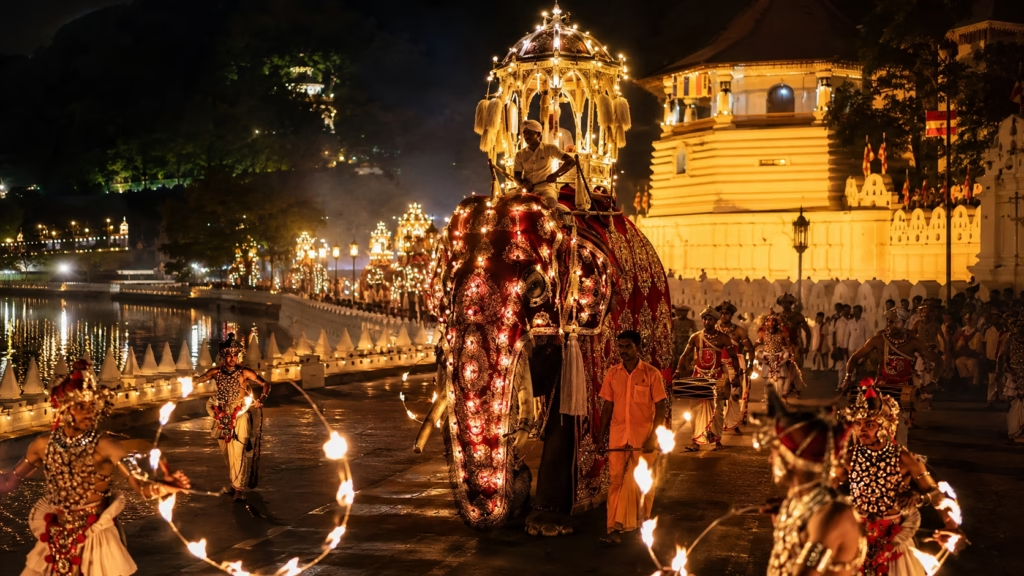
The city is home to the Temple of the Sacred Tooth Relic, one of the country’s most significant Buddhist sites.
If your trip coincides with the annual festival season, also read our guide to the Kandy Esala Perahera 2026.
Ella
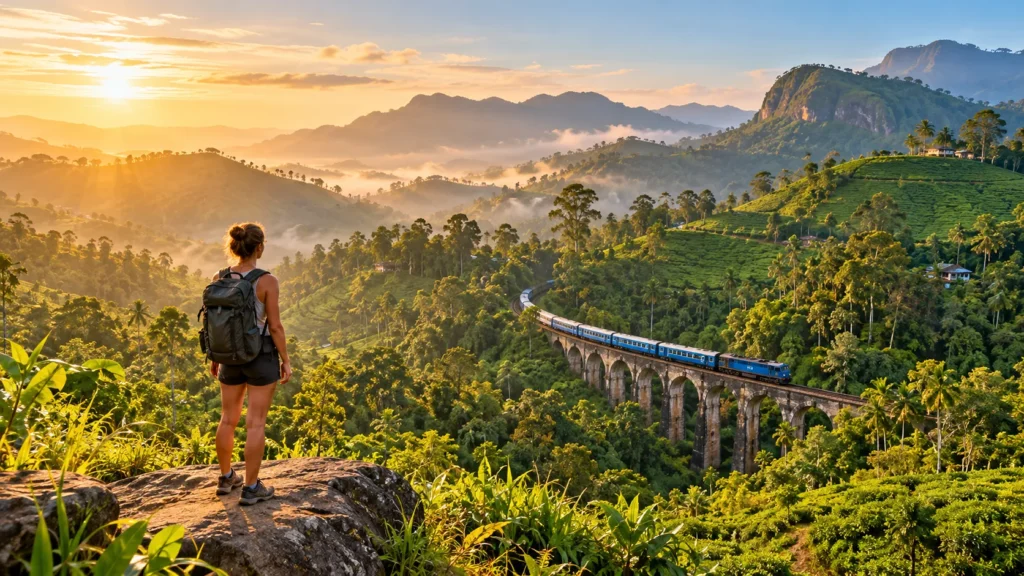
Ella has become one of the most popular hill-country stops for international travelers.
Visitors come for mountain scenery, tea-covered hills, Nine Arch Bridge, viewpoints, waterfalls and hiking.
Ella is also closely associated with Sri Lanka’s famous hill-country train journey.
Nuwara Eliya
Nuwara Eliya offers a cooler side of Sri Lanka.
The surrounding region is known for tea estates, mountain scenery, waterfalls and access to places such as Horton Plains.
Pack a light layer because temperatures here can feel very different from the coast.
Yala National Park
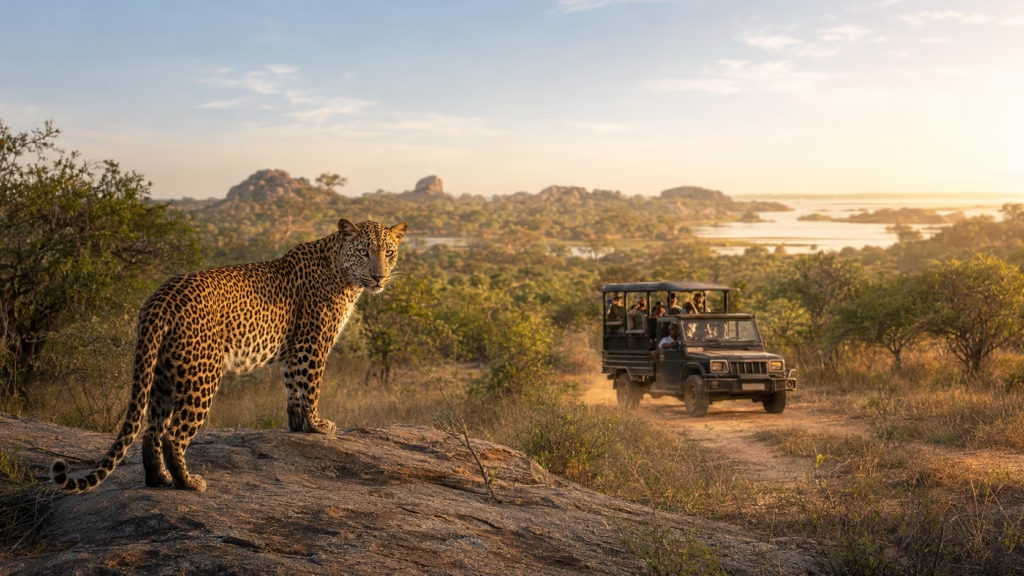
Sri Lanka is an excellent destination for wildlife experiences, and Yala is one of its best-known national parks.
Visitors may encounter elephants, crocodiles, deer, birdlife and, with some luck, leopards.
Read our complete Yala National Park Safari Guide 2026 before planning your safari.
Remember that wildlife sightings are never guaranteed, and ethical wildlife tourism should always prioritize animals over getting the perfect photograph.
Galle
Historic Galle Fort makes an excellent cultural stop on a south-coast itinerary.
The fortified old town combines colonial-era architecture, narrow streets, cafes, museums, boutiques and ocean views.
Galle also works well as a base for exploring several nearby beaches.
Mirissa
Mirissa is one of the best-known beach towns on Sri Lanka’s southern coast.
Travelers visit for beaches, sunsets, cafes and seasonal whale-watching trips.
The south coast can easily be combined with Galle, Unawatuna, Weligama and other coastal destinations.
Arugam Bay
Arugam Bay is on Sri Lanka’s east coast, not the south coast.
It is especially famous among surfers and attracts travelers looking for a relaxed beach atmosphere.
Because Sri Lanka’s east and west/south coasts have different weather patterns, the ideal time to visit Arugam Bay differs from the main south-coast season.
Jaffna and Northern Sri Lanka
Northern Sri Lanka offers a very different cultural experience from the more frequently visited southern routes.
Jaffna is known for Tamil culture, temples, distinctive regional cuisine and access to islands and coastal landscapes in the north.
Travelers with extra time should consider adding the region instead of limiting their journey to Sri Lanka’s classic tourist circuit.
How Many Days Do You Need in Sri Lanka?
There is no perfect trip length, but rushing Sri Lanka is one of the most common planning mistakes.
5–7 Days
With one week, focus on one balanced route rather than trying to see the entire country.
Possible combinations include:
Cultural Triangle → Kandy → Ella or Kandy → Ella → South Coast
10 Days
Ten days gives first-time visitors considerably more flexibility.
A route could combine cultural sites, the hill country, wildlife and the coast without trying to cover every region.
Read our 10 Days in Sri Lanka itinerary for a complete route.
14 Days
Two weeks is ideal for many independent travelers.
It gives you more time to slow down, include travel days and spend more than one night in key destinations.
Three Weeks or More
With three weeks, you can begin adding places such as the east coast, northern Sri Lanka, ancient cities or lesser-known destinations without constantly moving hotels.
ThaproVibe Tip: Sri Lanka looks compact, but road and rail journeys can be slow. Build your itinerary around realistic travel times rather than distance alone.
Best Time to Visit Sri Lanka
Sri Lanka can be visited throughout the year, but there is no single best month for the entire island.
The most important thing to understand is that weather differs by region.
South and West Coast
The drier period is generally associated with the months around December to April, making this a popular time for areas such as the south and southwest coast.
East Coast
Sri Lanka’s east coast often works better during a different part of the year, which is why destinations such as Arugam Bay and Trincomalee can be excellent alternatives when weather on the opposite coast is less favorable.
Hill Country
Kandy, Ella and Nuwara Eliya have cooler conditions than the coast, and rain can occur throughout the year.
Weather in Sri Lanka can still be unpredictable, so use seasonal patterns as a planning guide rather than a guarantee.
A dedicated Best Time to Visit Sri Lanka guide will be available on ThaproVibe for detailed regional and month-by-month planning.
Sri Lanka Visa and Entry Requirements in 2026
Visa rules can change, so this is one section you should always verify shortly before traveling.
Last verified: August 2026
Under Sri Lanka’s current ETA system, travelers should check whether they need an Electronic Travel Authorization (ETA) before arrival.
From 25 May 2026, nationals of 40 specified countries became eligible for a free 30-day tourist ETA under the current scheme. The list includes several major tourism markets such as Australia, Canada, China, France, Germany, India, Italy, Netherlands, New Zealand, Poland, Russia, the United Kingdom and the United States.
Rules and fees differ for travelers from other countries.
Always check your nationality and current requirements directly through the official Sri Lanka ETA website before booking or traveling.
Do not rely solely on an old blog post, social media video or third-party visa website for current entry requirements.
How to Travel Around Sri Lanka
Getting around Sri Lanka is part of the experience.
There is no single best form of transport. The right choice depends on your route, time and budget.
Trains
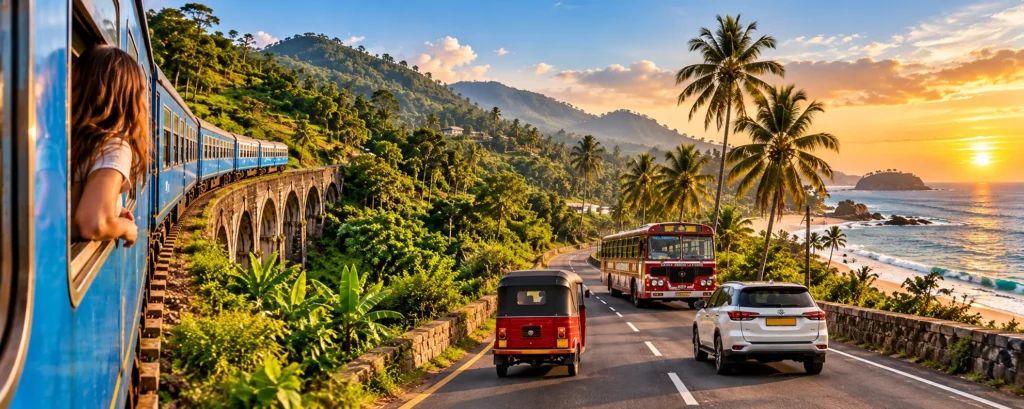
Train travel is popular with visitors, particularly through Sri Lanka’s hill country.
The journey through tea-growing regions around Kandy, Nanu Oya and Ella is famous for its scenery.
Reserved seats on popular services can sell out, so check the official Sri Lanka Railways reservation system when planning important journeys.
Buses
Buses connect cities, towns and many smaller destinations across the country.
They are inexpensive and useful for budget travelers, although journeys can be crowded and travel times may be longer than expected.
Tuk-Tuks
Tuk-tuks are useful for shorter journeys and local sightseeing.
Agree on the fare before starting when a meter or app-based price is not being used.
Ride-Hailing
Services such as PickMe and Uber can be useful in areas where they operate, especially around major urban centers.
Availability can vary depending on location.
Private Driver
A car with a driver can make sense for travelers with limited time or routes involving places that are difficult to connect efficiently by public transport.
ThaproVibe Maps and Directions
One of the goals of ThaproVibe is to make independent travel easier.
Browse our Sri Lanka travel locations to explore places on the map and plan directions to the destinations you want to visit.
How Much Does It Cost to Travel Sri Lanka?
Sri Lanka can suit several travel budgets, but there is no useful single daily figure for every traveler.
Your final cost depends heavily on:
- Accommodation style
- Private transport vs public transport
- Safari and attraction fees
- Food choices
- Surfing, whale watching and other activities
- How quickly you move between destinations
Budget Travelers
Backpackers can keep costs lower by using guesthouses, local restaurants, trains and buses.
Mid-Range Travelers
A mid-range trip may include boutique accommodation, a mix of public and private transport, paid attractions and organized activities.
Luxury Travelers
Luxury resorts, private transfers, premium safari experiences and high-end dining can increase the budget significantly.
Carry some Sri Lankan rupees even if you plan to use cards, particularly when traveling in smaller towns or paying for local transport and small purchases.
For detailed planning, use our upcoming Sri Lanka Travel Cost Guide.
Money, ATMs and Cards
Sri Lanka’s official currency is the Sri Lankan Rupee (LKR).
ATMs are widely available in major cities and tourism centers, and many hotels, restaurants and larger businesses accept cards.
However, cash remains useful for:
- Tuk-tuks
- Small restaurants
- Local buses
- Market purchases
- Rural areas
- Smaller attractions
Avoid carrying unnecessary amounts of cash and keep cards and money secure when traveling.
SIM Cards, Mobile Data and Internet
Having mobile data can make independent travel much easier.
It is useful for:
- Maps and directions
- Ride-hailing
- Train and bus planning
- Accommodation communication
- Translation
- Checking weather
- Finding restaurants and attractions
Local SIM cards and mobile-data packages are available, while many travelers also choose an eSIM before arrival.
Wi-Fi is common in hotels, guesthouses, cafes and coworking spaces, although speed and reliability can vary.
Sri Lankan Food You Should Try
Food should be part of your Sri Lanka itinerary, not an afterthought.
Start with:
Rice and Curry
A Sri Lankan rice-and-curry meal usually includes several curries, vegetables, sambols and other accompaniments rather than one single curry.
Kottu
Kottu is one of the country’s most popular street-food-style dishes, made by chopping flatbread together with vegetables, spices and other ingredients on a hot griddle.
Hoppers
Hoppers are bowl-shaped pancakes often eaten with curry, sambol or an egg cooked in the center.
String Hoppers
These thin steamed rice-noodle nests are commonly served with curry and coconut-based accompaniments.
Seafood
Coastal areas offer plenty of seafood choices, while cuisine in northern Sri Lanka has its own distinctive flavors and traditions.
If you have allergies or dietary restrictions, explain them clearly rather than assuming every dish will be prepared the same way.
Is Sri Lanka Safe for Tourists?
Avoid treating any destination as completely risk-free.
Sri Lanka receives large numbers of international visitors and has a dedicated Tourist Police service, but travelers should still take normal precautions.
Keep an eye on valuables, use reputable transport providers, avoid leaving belongings unattended and pay attention to local conditions.
Road safety, ocean conditions, wildlife, heat and mosquito-borne illnesses can also be relevant depending on your activities.
Travel advisories can change, so check the latest advice issued by your own government before departure.
Solo travelers should also share important travel details with someone they trust and avoid unnecessary risks when moving around late at night or in isolated places.
Temple Etiquette and Local Customs
Sri Lanka is a multicultural country with strong Buddhist, Hindu, Muslim and Christian traditions.
When visiting religious places:
- Dress modestly.
- Cover shoulders and knees where required.
- Remove shoes and hats before entering appropriate temple areas.
- Follow signs and local instructions.
- Do not treat religious statues as casual photo props.
- Ask before photographing people, ceremonies or worshippers.
- Be respectful when religious services are taking place.
Small gestures of respect make a big difference when traveling through Sri Lanka.
What to Pack for Sri Lanka
Your packing list depends on where you are traveling.
Useful basics include:
- Lightweight, breathable clothing
- Modest clothing for temples
- Comfortable walking shoes
- Sandals or flip-flops
- Lightweight rain protection
- Sunscreen
- Mosquito repellent
- Reusable water bottle
- Universal travel adapter
- Basic medication
- Power bank
- Swimwear
- Day bag
- A light jacket or warm layer for the hill country
If you plan to hike, surf or spend significant time outdoors, adapt your packing list to those activities.
Best Experiences in Sri Lanka
Places matter, but the experiences between them often become the best travel memories.
Consider adding some of these to your itinerary:
Ride Through the Hill Country by Train
Sri Lanka’s railway journey through the central highlands is one of the country’s signature travel experiences.
Go on a Wildlife Safari
National parks including Yala offer opportunities to experience Sri Lanka’s remarkable biodiversity.
Read our Yala National Park Safari Guide 2026 before booking.
Explore Ancient Sri Lanka
Sigiriya, Dambulla, Anuradhapura and Polonnaruwa reveal different chapters of the island’s ancient history.
Experience Tea Country
Explore the landscapes around Nuwara Eliya and Ella and learn more about Sri Lanka’s tea-growing regions.
Spend Time on the Coast
Choose the coast according to your travel season rather than automatically heading south.
Eat Local Food
Try local restaurants, markets, bakeries and family-run businesses as well as restaurants aimed at tourists.
Experience a Cultural Festival
If your dates align, Sri Lanka’s religious and cultural events can add another dimension to your trip.
Traveling around Kandy during festival season? Read our Kandy Esala Perahera 2026 Guide.
Common Mistakes to Avoid in Sri Lanka
A little planning can save a lot of time.
Trying to See Too Much
Do not plan your trip based only on distances shown on a map.
Allow realistic travel days.
Ignoring the Monsoons
A beach that is perfect in one season may not be the best choice in another.
Booking Popular Train Journeys Too Late
Check reservations early for important routes.
Carrying No Cash
Cards are useful, but they do not replace cash everywhere.
Treating Temples Like Tourist Attractions
Religious places remain active places of worship. Dress and behave accordingly.
Assuming Every Wildlife Sighting Is Guaranteed
Nature does not work according to a tour schedule.
Choose responsible operators and enjoy the overall experience rather than chasing one animal.
Latest Sri Lanka Travel Updates
Entry rules, transport services, attraction access, weather conditions and tourism policies can change.
Before and during your trip, check the latest Sri Lanka Travel News on ThaproVibe for useful visitor updates.
For official matters such as immigration and visa rules, always confirm details through the relevant Sri Lankan government authority.
Start Planning Your Sri Lanka Trip with ThaproVibe
Sri Lanka is not a destination you need to rush.
Give yourself time to experience its landscapes, food, wildlife, cultural traditions and the everyday moments between major attractions.
ThaproVibe is designed to help you travel around Sri Lanka independently with useful destination guides, local travel information, maps, directions, itineraries and current tourism updates.
Start exploring: Best Places to Visit in Sri Lanka
Already planning your route? Read our 10 Days in Sri Lanka guide and build your journey one destination at a time.
And before you travel, check our latest Sri Lanka travel news for current visitor information.